
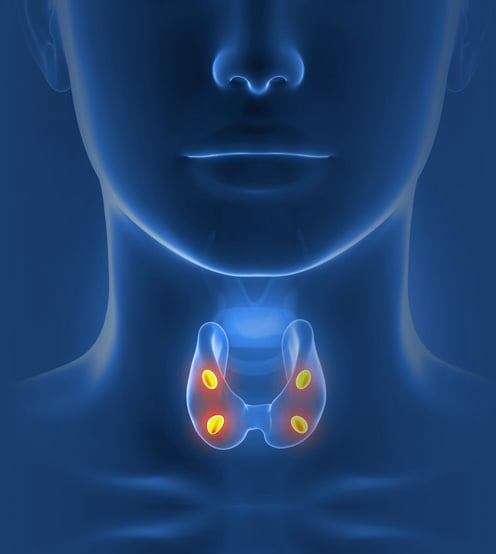
When is parathyroid gland surgery needed?
The most common reason for parathyroid surgery is for a benign (non-cancerous) tumour of one of the parathyroid glands. This is called a parathyroid adenoma. Occasionally these tumours affect more than one gland. Overgrowth of all four glands can occur in people on dialysis for kidney failure. These are not usually adenomas and are due to parathyroid hyperplasia (overgrowth). Cancer of the parathyroid glands is rare. In all of these conditions, excess parathyroid hormone is produced, usually leading to increalised calcium levels in the blood. This is often asymptomatic but can result in kidney stones, gastrointestinal upset, osteoporosis, fatigue and occasionally neuropsychiatric disturbances.
Parathyroidectomy
Parathyroidectomy is removal of one, or more of the parathyroid glands. Removal of one parathyroid adenoma is the most common operation reason for this operation. A well-localised gland can be removed through a small (2-3cm) incision in the neck. This is called a minimally invasive parathyroid surgery (MIPS). Sometimes glands are not well localised, the localised gland cannot be found, or more than one gland needs to be removed. In this event the operation is conducted through a larger (4-5cm) incision. This is called an open parathyroidectomy, or sometimes a four-gland exploration.
Pre-operative Preparation
Prior to your operation you may need to attend a Preadmissions Clinic. Your fitness for surgery will be assessed, tests may be ordered and referrals to other specialists arranged if required.
You cannot eat for 6 hours prior to your operation. You may sip water for up to 2 hours prior to your operation. Fasting decreases the risk of vomiting and aspiration during induction of anaesthesia. Aspiration can cause pneumonia and a prolonged stay in hospital.
Anaesthesia
Parathyroidectomy is done under general anaesthesia. You will be asleep during the whole procedure. The anaesthetist will discuss the anaesthetic with you prior to your operation. They will see you in the pre-operative area and accompany you to the operating theatre.
Procedure
Following general anaesthesia, you are positioned on the operating table, your neck is marked, and local anaesthetic is injected to decrease post-operative discomfort. An incision is made across the lower part of the neck. The affected parathyroid is removed. If it cannot be found, extension of the wound may be required, and a four-gland exploration conducted. Care is taken to identify and preserve the recurrent laryngeal nerves and unaffected parathyroid glands. At the end of the operation, the skin is closed with absorbable sutures and dressed with transparent lilac coloured glue and a transparent dressing. MIPS usually takes about 20-30 minutes. A four-gland exploration can take as long as 2-3 hours.
Initial recovery
Following the operation, you will wake up in the recovery area. You will feel a little disoriented and may feel a little nauseous. The staff in recovery are equipped to help you. Immediate post-operative pain is usually minimal. Once you are awake and oriented, you will be taken to a ward bed. After a few hours, and once the nurses are satisfied that it is safe, you can get out of bed.
Post-operative course
Most patients who have a parathyroidectomy will spend one night in hospital. You will have one blood test in the recovery area and another one the morning after surgery (if you stay the night). This is to check your parathyroid hormone and calcium level.
A few patients require calcium supplementation, and a few will require Vitamin D tablets temporarily.
Please do not drive yourself home from the hospital but rather arrange a family member or friend to come and pick you up.
Diet and return to activity
There are no dietary restrictions or special dietary supplements that are required after thyroid surgery. You may eat whatever you choose. Paracetamol is usually all that is required for pain relief. You may bathe and shower. The wound is waterproof and can get wet.
You should avoid strenuous physical activity for two weeks after your operation. It increases the risk of post-operative bleeding which could result in an emergency trip back to the operating theatre. Once this period has passed and you feel that you have recovered, you may return to your normal physical activities.
Driving
There is no specific law covering surgery and driving. It is not advisable to drive immediately after surgery. In general, in order to return to driving, you must:
- Have a valid drivers’ licence
- Be able to control your vehicle during an emergency
- Be able to testify in court as to your capacity to drive
Your car insurer may not cover you following an accident if:
- You have had recent surgery (‘recent’ is not clearly defined)
- You are taking pain or sedative medications that may impair your concentration or judgement
Aim to return to driving when:
- You are pain free
- You have full range of motion
- You are not taking strong pain medications or sedatives
- Your reaction time is not compromised
If you are in doubt, do not drive. Call your insurer for advice.
Wound Management
Post-operative swelling around the wound is normal and usually resolves within a month or so. No specific wound management is needed in the first two weeks while the dressings are on. After this, gentle scar massage is advisable for 10 minutes two or three time a day for 6 months. You may use whatever moisturising lotion you like (e.g. sorbolene, bio-oil etc.) but creams with Vitamin E should be avoided for the first post-operative month. Alternatively, you can keep the scar covered with a silicon strip for 12 hours a day for 6 months. These strips are available from the chemist but are quite costly.
Initially the scar will be pink. Over 6-12 months, the scar will fade until it becomes pale.
Complications
Post-operative complications are uncommon but do occur:
Short-term
Follow up
A follow-up appointment should be arranged in rooms, 4-6 weeks after surgery for a post-operative check-up. At this appointment, your wounds will be assessed, blood tests checked, and any further investigations and management arranged.
Please call to arrange a convenient time. Prior to attending, please have a blood test for thyroid and parathyroid function. A request form will be supplied to you prior to your discharge from hospital.
Personalised Q&A
Access personalised, evidence-based answers about your procedure with our Medical AI tool. Powered by Perplexity and backed by the latest medical literature, it provides accurate, up-to-date information tailored to your specific questions.
Tell Us About Yourself
Please provide your health information so we can personalise answers to your situation.
This information is used only to personalize your responses and is not stored permanently.