
When is parotid surgery needed?
The most common reason for parotid surgery is a benign (non-cancerous) tumour of the parotid gland. The most common of these is a pleomorphic adenoma. These are slow growing and usually present as a painless lump in front of, or below the ear. Occasionally they are discovered incidentally during investigations for other conditions. Cancers of the parotid gland are uncommon. They usually present similarly to a pleomorphic adenoma but may have other symptoms or signs such as rapid growth, partial or complete facial paralysis, strange sensations or pain of the ear, jaw or face, or a lump in the neck.
Parotidectomy
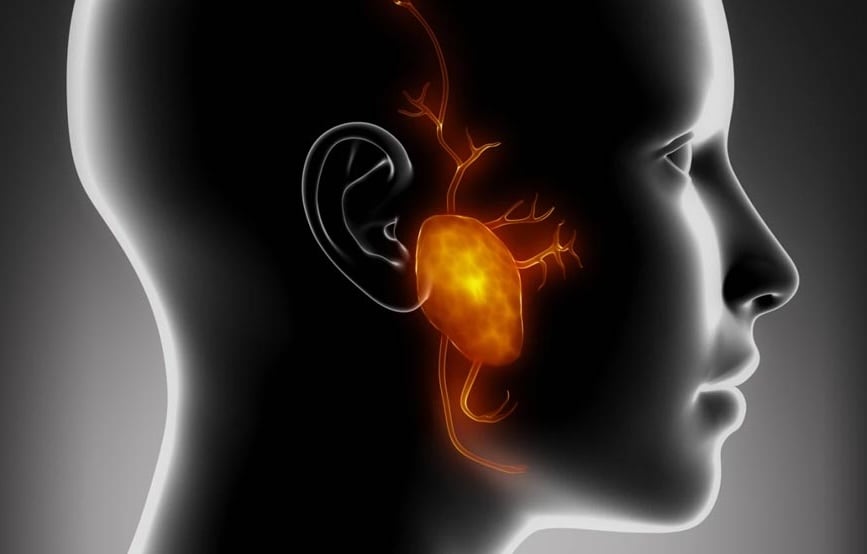
Parotidectomy is removal of part or all of the parotid gland. Removal of the superficial lobe of the parotid is the most common parotid operation. Occasionally the deep lobe or accessory lobe are also removed. The parotid is removed via an incision in front of the ear. If the operation is being done for a malignancy (cancer), the incision is extended onto the neck so that the lymph nodes of the upper neck can also be removed. This is to check if the cancer has spread to these nodes. Rarely, a parotid malignancy has invaded the facial nerve, skin or underlying jaw and more radical surgery and reconstruction is required. This may require the services of a Plastic & Reconstructive Surgeon.
Pre-operative Preparation
Prior to your operation you may need to attend a Preadmissions Clinic. Your fitness for surgery will be assessed, tests may be ordered and referrals to other specialists arranged if required.
You cannot eat for 6 hours prior to your operation. You may sip water for up to 2 hours prior to your operation. Fasting decreases the risk of vomiting and aspiration during induction of anaesthesia. Aspiration can cause pneumonia and a prolonged stay in hospital.
Anaesthesia
Parotidectomy is done under general anaesthesia. You will be asleep during the whole procedure. The anaesthetist will discuss the anaesthetic with you prior to your operation. They will see you in the pre-operative area and accompany you to the operating theatre.
Procedure
Following general anaesthesia, you are positioned on the operating table, your face and neck are marked, and local anaesthetic is injected to decrease post-operative discomfort. An incision is made in the skin crease in front of your ear and extended a variable distance onto the neck. The skin is retracted forward and the trunk of the facial nerve is located. The five branches of the facial nerve are then identified and dissected out, and the superficial lobe of the parotid gland is lifted off them. The deep lobe is occasionally removed in continuity with the superficial lobe but is more commonly removed separately.
If the tumour is malignant and a branch or branches of the facial nerve pass through it, those branches are removed with the tumour. In addition, the lymph nodes of the upper neck may need to be removed.
At the end of the operation a small silicone drain is placed in the operative space and brought out through the skin. It remains in place for 2-4 days.
Reconstructive Surgery
This does not apply to most patients who undergo parotid surgery.
This is occasionally required if there is loss of cheek skin, structures of the ear, underlying jaw-bone or mastoid, and/or most commonly, loss of one or more branches of the facial nerve. The degree of the reconstruction required may involve passive facial reanimation, facial nerve grafts, skin flaps or grafts and/or free tissue transfer from other parts of the body. Some reconstructive operations are highly specialised and require the services of a Plastic and Reconstructive Surgeon.
Initial recovery
Following the operation, you will wake up in the recovery area. You will feel a little disoriented and may feel a little nauseous. The staff in recovery are equipped to help you. Immediate post-operative pain is usually minimal. Once you are awake and oriented, you will be taken to a ward bed. After a few hours, and once the nurses are satisfied that it is safe, you can get out of bed.
Diet and return to activity
There are no dietary restrictions or special dietary supplements that are required after parotid surgery. You may eat whatever you choose. Oral analgesia including paracetamol is usually all that is required for pain relief. You may bathe and shower. The wound is waterproof and can get wet.
You should avoid strenuous physical activity for two weeks after your operation. It increases the risk of post-operative bleeding which could result in a trip back to the operating theatre. Once this period has passed and you feel that you have recovered, you may return to your normal physical activities.
Driving
There is no specific law covering surgery and driving. It is not advisable to drive immediately after surgery. In general, in order to return to driving, you must:
- Have a valid drivers’ licence
- Be able to control your vehicle during an emergency
- Be able to testify in court as to your capacity to drive
Your car insurer may not cover you following an accident if:
- You have had recent surgery (‘recent’ is not clearly defined)
- You are taking pain or sedative medications that may impair your concentration or judgement
Aim to return to driving when:
- You are pain free
- You have full range of motion
- You are not taking strong pain medications or sedatives
- Your reaction time is not compromised
If you are in doubt, do not drive. Call your insurer for advice.
Wound Management
Post-operative swelling around the wound is normal and usually resolves within a month or so. No specific wound management is needed in the first two weeks while the dressings are on. After this, gentle scar massage is advisable for 10 minutes two or three time a day for 6 months. You may use whatever moisturising lotion you like (e.g. sorbolene, bio-oil etc.) but creams with Vitamin E should be avoided for the first post-operative month. Alternatively, you can keep the scar covered with a silicon strip for 12 hours a day for 6 months. These strips are available from the chemist but are quite costly.
Initially the scar will be pink. Over 6-12 months, the scar will fade until it becomes pale.
Complications
Bleeding
This occurs in <5% patients and is usually self-limiting. Occasionally a return to theatre is required for evacuation of blood clot from the wound.
Wound Infection
These can complicate any type of surgery and can usually be treated with a short course of oral antibiotics. Uncommonly, IV antibiotics or further surgery is required.
Facial Nerve Palsy
This occurs in one or more branches of the facial nerve in about 10% parotid surgery. It is usually due to stretching of the nerve. It results in paralysis of some or all of the facial nerves on the side that the nerve is affected. Most palsies are temporary but occasionally they are permanent. Permanent facial nerve palsy more commonly occurs when the nerve is intentionally sacrificed in order to surgically clear the tumour.
Salivary Fistula
This is an abnormal connection between the remaining parotid gland and the wound incision. Saliva produced by the remaining gland exits via the skin. It is increalised as a result of stimuli that induce normal salivation. They are usually self-limiting but may require treatment with various medications and/or surgery.
Gustatory Sweating
This is sweating of the face that occurs due to stimuli that cause normal salivation. It occurs because of ‘cross-wiring’ of the autonomic nerves supplying the remaining parotid gland and the nerves to the sweat glands of the overlying skin. This is rare.
Follow up
A follow-up appointment should be arranged in rooms 2 weeks after your operation for a discussion regarding pathology. Another appointment will be required 4-6 weeks after surgery for a post-operative check-up. At this appointment, your wounds will be assessed, and any further investigations and management arranged. Please call to arrange a convenient time.
Personalised Q&A
Access personalised, evidence-based answers about your procedure with our Medical AI tool. Powered by Perplexity and backed by the latest medical literature, it provides accurate, up-to-date information tailored to your specific questions.
Tell Us About Yourself
Please provide your health information so we can personalise answers to your situation.
This information is used only to personalize your responses and is not stored permanently.