How does soft tissue sarcoma present?
When it occurs in the limbs, neck or body wall, soft tissue sarcoma most commonly presents as a painless lump. In the abdomen or chest cavities, sarcoma may not become apparent until it is very big, at which point may felt as a lump or it may cause pain or functional problems by pressing on nearby organs.
How is soft tissue sarcoma diagnosed?
Soft tissue sarcoma is diagnosed with a biopsy. There are two types of biopsy in common use:
- Core biopsy - This involves taking samples of the tumour by passing a hollow needle into it. It often requires ultrasound or CT guidance and is most commonly done by a radiologist.
- Incisional biopsy - This involves surgical removal of part of the tumour.
Biopsy of a sarcoma is a specialised process and must take into account any planned future surgery. Once taken, the samples are examined under the microscope by a pathologist who is experienced in differentiating between the different kinds of sarcoma.
How is soft tissue sarcoma staged?
The process of staging informs prognosis and treatment. Information required for staging includes the size and grade of the tumour, and whether it has spread to surrounding organs, the nearby lymph nodes, or organs distant to the tumour like the liver and lungs. A number of tests are required to stage the sarcoma including:
- Biopsy – This provides information on sarcoma grade. Sarcomas can be low, intermediate or high grade.
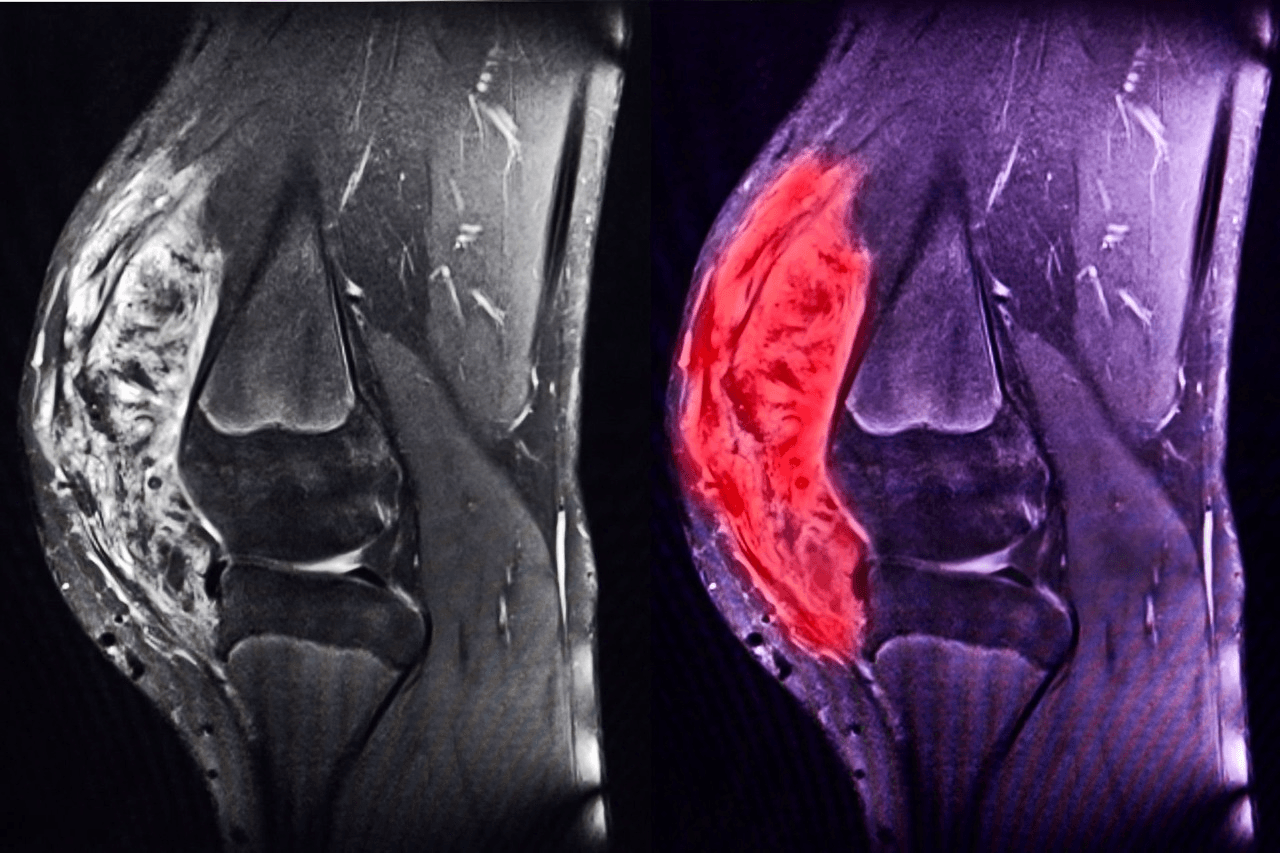
- MRI scan – This is used to scan the sarcoma and the surrounding tissues and organs to give a detailed picture of its local extent. It is very useful for operative planning.
- CT & PET scan – These are used to see if the sarcoma has spread to other parts of the body
There is no standard staging system for soft tissue sarcoma of the head, neck, chest or abdomen.
For soft tissue sarcoma of the trunk, arms and legs in adults, the following stages are used:
Stage I
- IA – Tumour < 5cm and low grade
- IB – Tumour > 5cm and low grade
Stage II
- Tumour < 5cm and intermediate or high grade
Stage III
- IIIA – Tumour > 5cm but <10cm and intermediate or high grade
- IIIB – Tumour > 10cm and intermediate or high grade
Stage IV
- Tumour has spread to nearby lymph nodes or other parts of the body
For soft tissue sarcoma of the retroperitoneum, the following stages are used:
Stage I
- IA – Tumour < 5cm and low grade
- IB – Tumour > 5cm and low grade
Stage II
- Tumour < 5cm and intermediate or high grade
Stage III
- IIIA – Tumour > 5cm but <10cm and intermediate or high grade
- IIIB
- Tumour >10cm and intermediate or high grade
- Tumour has spread to nearby lymph nodes
Stage IV
- Tumour has spread to other parts of the body
How is soft tissue sarcoma treated?
Soft tissue sarcoma is treated by teams of highly specialised practitioners who may include surgical oncologists, medical oncologists, radiation oncologists, radiologists, nuclear medicine physicians, pathologists, nurses, occupational and physiotherapists, speech therapists and dieticians.
There are three standard types of treatment for soft tissue sarcoma. They are surgery, chemotherapy and radiotherapy. In addition, there are new types of treatments that are being tested as part of clinical trials. These therapies complement each other and are used together in combinations that depend on the particular type, site and stage of the sarcoma.
Surgery
Surgery is the most common form of treatment for soft tissue sarcoma. For some sarcomas, surgery is the only treatment that is required. The aim of sarcoma surgery is the complete removal of the tumour with a margin of healthy tissue.
When sarcoma occurs in the limbs, the aim is to remove the tumour and preserve the function of the limb. If the tumour cannot be removed, the function of the limb cannot be preserved, or the tumour recurs in a limb after it has been treated, amputation is occasionally required. If the sarcoma has spread to nearby lymph nodes, they may also need to be removed.
If the tumour occurs within a body cavity, achieving a margin of healthy tissue can be challenging and may mean the removal of organs or parts of organs which are affected by tumour.
Radiotherapy
Radiotherapy uses high energy radiation to kill cancer cells. It can be given by a machine external to the body, or by radioactive substances implanted in needles, seeds, wires or catheters placed near to or directly into the sarcoma.
In the treatment of soft tissue sarcoma, radiotherapy is used in a few different ways. Occasionally it is used as definitive therapy to kill the tumour. More frequently it is used prior to, or after surgery. It may aid surgical resection by shrinking the tumour and may also prevent it from recurring once therapy is complete. It is also used to treat deposits that have spread away from the main tumour. The method and timing of radiotherapy depends on the type and stage of the cancer being treated.
Chemotherapy
Chemotherapy is cancer treatment that uses drugs to kill or stop the growth of cancer cells. These drugs commonly target the cancer cells' ability to divide, destroy its DNA or hamper its' metabolism. Chemotherapy is occasionally used prior to surgery in order to shrink the tumour and make it more easily removable. It is more commonly used after surgery to mop up any cancer cells that may have spread around the body prior to the main tumour being removed.
Other Treatments
Regional Chemotherapy
These are not new treatments, but new anti-cancer drugs are rekindling interest in these methods. Isolated limb perfusion and infusion are techniques where the blood supply to an affected limb is temporarily interrupted with a tourniquet. High-dose chemotherapy is then injected directly into the blood vessel of that limb. Hepatic artery and portal vein infusion chemotherapy uses a similar principle to treat sarcoma that started in or spread to the liver.
Targeted Therapy
Numerous agents have been tested that directly target known genetic abnormalities within the sarcoma. Success with these agents has been variable and they are frequently the subject of clinical trials.
Personalised Q&A
Access personalised, evidence-based answers about your procedure with our Medical AI tool. Powered by Perplexity and backed by the latest medical literature, it provides accurate, up-to-date information tailored to your specific questions.
Tell Us About Yourself
Please provide your health information so we can personalise answers to your situation.
This information is used only to personalize your responses and is not stored permanently.