
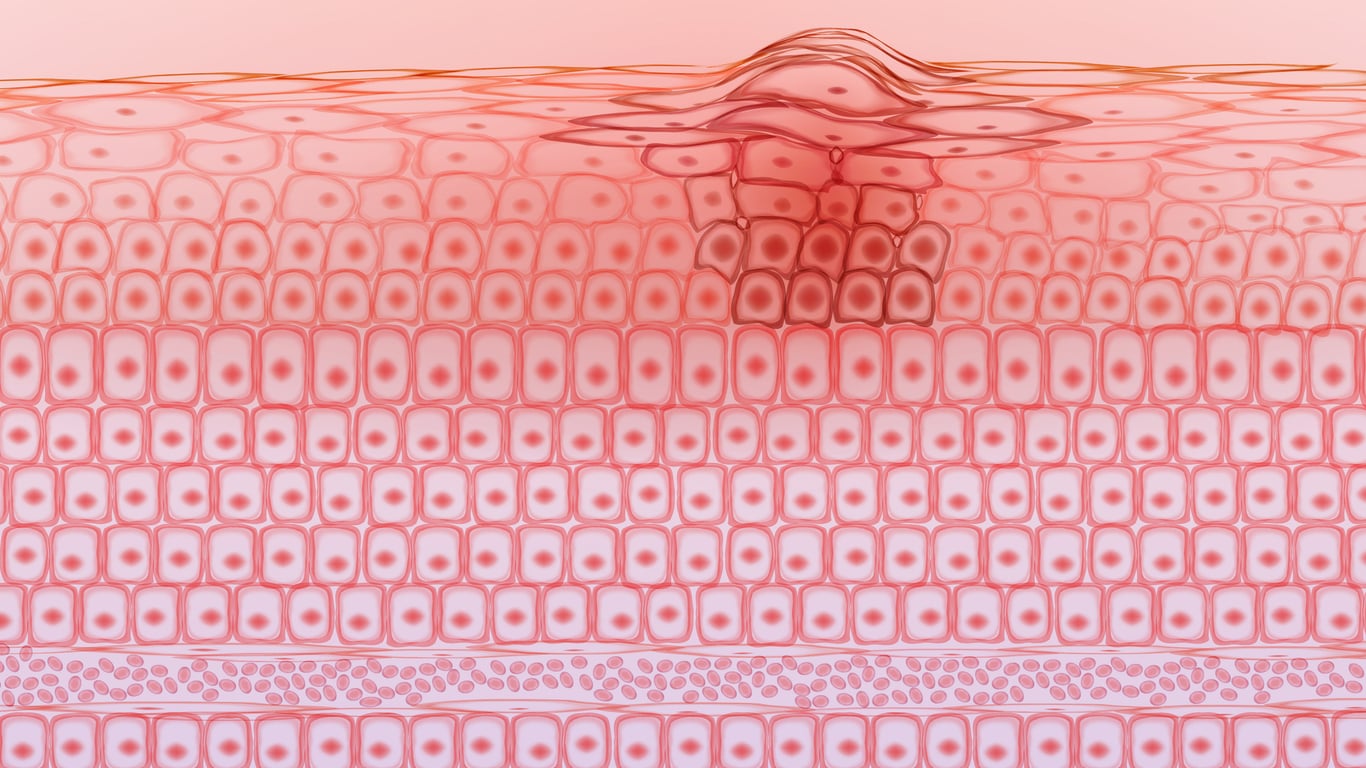
What causes melanoma?
Melanoma is caused by genetic mutations within the affected melanocytes leading to their uncontrolled, unregulated growth. Excessive exposure to UV light from the sun or solariums is the most common cause of these mutations. Risk factors for the development of these mutations include fair skin, freckles, red and fair hair, blue eyes, a high mole count and patterns of sunburn in childhood.
Rarely, melanoma can also occur in non-sun exposed areas like the soles of the feet, oral cavity, anus and genitals.
Is melanoma hereditary?
Melanoma occurs with increalised frequency in people who have a family history of it. This is usually related to hereditary risk factors and behaviour patterns that increase or decrease the chances of developing melanoma. Very rarely, it is related to hereditary genetic syndromes that affect specific genes.
Is melanoma preventable?
Though your hereditary risk factors for melanoma are not modifiable, melanoma is usually preventable. Avoiding unsafe levels of UV exposure, particularly in childhood, is the most important way to prevent it. Exposure to sunlight between 10am and 4pm should be avoided, especially during summer. Whenever out in the sun, wear a hat, protective clothing and high SPF sunscreen – even on cloudy days. Thankfully, solaria are now banned in Australia.
How is melanoma diagnosed?
Melanoma is usually diagnosed when you, one of your family members or a doctor notices a new mole or a significant change in an old mole. This may include growth, colour change, bleeding, itch or pain. Once a melanoma is suspected, a full skin-check, as well as a physical examination of the lymph nodes of the neck, armpits and groin is conducted.
To confirm the diagnosis, a biopsy is required in which part or all of the suspect mole is removed. This can usually be done by a GP, dermatologist or surgeon under local anaesthetic. The specimen is sent to a pathologist for analysis. It takes about a week for a result to become available.
What are the stages of melanoma?
The aims of ‘staging’ are to determine if the melanoma is in the skin only, has spread to the local lymph nodes, or has spread beyond them to other parts of the body. How we treat you depends largely on the staging. The table below shows a simplified version of melanoma staging and stage-specific treatment.
How is melanoma treated with surgery?
The wound is usually closed with sutures. If the defect is too large to be closed, skin from the neighbouring area is mobilised to cover the defect, or skin is brought from elsewhere as a graft.
Wound management
Post-operative swelling around the wound is normal and usually resolves within a month or so. No specific wound management is needed in the first two weeks while the dressings are on. After this, gentle scar massage is advisable for 10 minutes two or three time a day for 6 months. You may use whatever moisturising lotion you like (e.g. sorbolene, bio-oil etc.) but creams with Vitamin E should be avoided for the first post-operative month. Alternatively, you can keep the scar covered with a silicon strip for 12 hours a day for 6 months. These strips are available from the chemist but are quite costly.
Initially the scar will be pink. Over 6-12 months, the scar will fade until it becomes pale.
Physiotherapy
Post-operative physiotherapy is highly recommended starting on the first day following surgery. You should continue physiotherapy after you leave hospital and seek the services of a community physiotherapist until your rehabilitation is complete. This is the best way to ensure that your pre-operative function is retained after surgery.
Complications
Bleeding
This is uncommon. If it occurs, blood collects under the skin which can be uncomfortable. Occasionally this requires a trip back to the operating theatre so that the blood can be evacuated.
Infection
These can complicate any type of surgery and can usually be treated with a short course of oral antibiotics. Uncommonly, IV antibiotics or further surgery is required
Seroma
This is a collection of fluid in the wound bed beneath the skin. They usually resolve on their own but can be uncomfortable and sometimes need to be aspirated. Occasionally they can get infected
Lymphoedema
This is swelling of the limb beyond the lymph node bed and occurs in about 5% patients. It is usually mild and self-limiting. It is more common when all of the lymph nodes are removed (lymphadenectomy)
Non-localisation
Sometimes the sentinel lymph node cannot be found. This is usually because the lymphoscintogram did not map the sentinel lymph node.
Pre-operative preparation
Prior to your operation you may need to attend a Preadmissions Clinic. Your fitness for surgery will be assessed, tests may be ordered and referrals to other specialists arranged if required.
You cannot eat for 6 hours prior to your operation. You may sip water for up to 2 hours prior to your operation. Fasting decreases the risk of vomiting and aspiration during induction of anaesthesia. Aspiration can cause pneumonia and a prolonged stay in hospital.
Anaesthesia
Melanoma surgery is sometimes done under local anaesthesia but usually done under general anaesthesia. If your surgery is to be done under general anaesthesia, you will be asleep during the whole procedure. The anaesthetist will discuss the anaesthetic with you prior to your operation. They will see you in the pre-operative area and accompany you to the operating theatre.
Operation
Following general anaesthesia, you are positioned on the operating table, the melanoma is marked with appropriate margins, and local anaesthetic is injected to decrease post-operative discomfort. A skin incision is made along the marks and the melanoma is removed. If the wound can be closed it is done in layers. Depending on the characteristics of the wound, absorbable or non-absorbable (nylon) sutures are used. The nylon sutures will need to be removed 5 days to 3 weeks after your operation.
Reconstructive surgery
This does not apply to most patients who undergo melanoma surgery.
If the skin defect is too large to close, skin can be moved over from an adjacent area to cover it. This is called a ‘local flap’.
Sometimes a skin graft is used. The graft is taken from a different area of the body and fastened to the defect. Grafts can be ‘full thickness’ or partial thickness (split skin) grafts. Full thickness grafts are often taken from areas with skin redundancy like the inner arm or neck. Split skin grafts are often taken from the thigh. Donor and recipient site skin graft dressings should stay in-tact for 2 weeks.
Some reconstructive operations are highly specialised and require the services of a Plastic and Reconstructive Surgeon.
Initial recovery
Following the operation, you will wake up in the recovery area. You will feel a little disoriented and may feel a little nauseous. The staff in recovery are equipped to help you. Immediate post-operative pain is usually minimal. Once you are awake and oriented, you will be taken to a ward bed. After a few hours, and once the nurses are satisfied that it is safe, you can get out of bed.
Diet and return to activity
There are no dietary restrictions or special dietary supplements that are required after melanoma surgery. You may eat whatever you choose. Oral analgesia including paracetamol is usually all that is required for pain relief. You may bathe and shower. The wound is waterproof and can get wet.
You should avoid strenuous physical activity for two weeks after your operation. It increases the risk of post-operative wound complications which could result in a trip back to the operating theatre. Once this period has passed and you feel that you have recovered, you may return to your normal physical activities.
Other melanoma therapies
Radiation Therapy
This mode of therapy uses radiation to kill cancer cells. It is sometimes used to treat melanoma that spread from the primary lesion. Occasionally it is used to treat the primary lesion as an alternative to, or following surgery.
Targeted Therapy
These are relatively new and innovative drugs that exploit genetic targets within melanoma cells to slow or stop their growth. They can be used before or after surgery and are mostly reserved for those who have metastatic disease. Targeted therapy is usually used to treat melanoma that has spread to the lymph nodes or beyond.
Immunotherapy
Melanoma has a sophisticated way of hiding from the body’s immune system. These elegant drugs disable that ability. Consequently, the immune system ‘turns on’ and, recognising the melanoma as foreign, attacks and destroys it. Immunotherapy is usually used to treat melanoma that has spread to the lymph nodes or beyond.
Chemotherapy
Traditional chemotherapy for the treatment of melanoma is rarely used. It was once a last resort for metastatic disease but was never particularly effective and has all but been abandoned.
A follow-up appointment should be arranged in rooms 2 weeks after your operation for a discussion regarding pathology. Another appointment will be required 4-6 weeks after surgery for a post-operative check-up. At this appointment, your wounds will be assessed, and any further investigations and management arranged. Please call to arrange a convenient time.
Follow up
A follow-up appointment should be arranged in rooms 2 weeks after your operation for a discussion regarding pathology. Another appointment will be required 4-6 weeks after surgery for a post-operative check-up. At this appointment, your wounds will be assessed, and any further investigations and management arranged. Please call to arrange a convenient time.
Driving
There is no specific law covering surgery and driving. It is not advisable to drive immediately after surgery. In general, in order to return to driving, you must:
- Have a valid drivers’ licence
- Be able to control your vehicle during an emergency
- Be able to testify in court as to your capacity to drive
Your car insurer may not cover you following an accident if:
- You have had recent surgery (‘recent’ is not clearly defined)
- You are taking pain or sedative medications that may impair your concentration or judgement
Aim to return to driving when:
- You are pain free
- You have full range of motion
- You are not taking strong pain medications or sedatives
- Your reaction time is not compromised
If you are in doubt, do not drive. Call your insurer for advice.
Personalised Q&A
Access personalised, evidence-based answers about your procedure with our Medical AI tool. Powered by Perplexity and backed by the latest medical literature, it provides accurate, up-to-date information tailored to your specific questions.
Tell Us About Yourself
Please provide your health information so we can personalise answers to your situation.
This information is used only to personalize your responses and is not stored permanently.